
Available on these platforms: Spotify | Anchor | Apple | PocketCasts
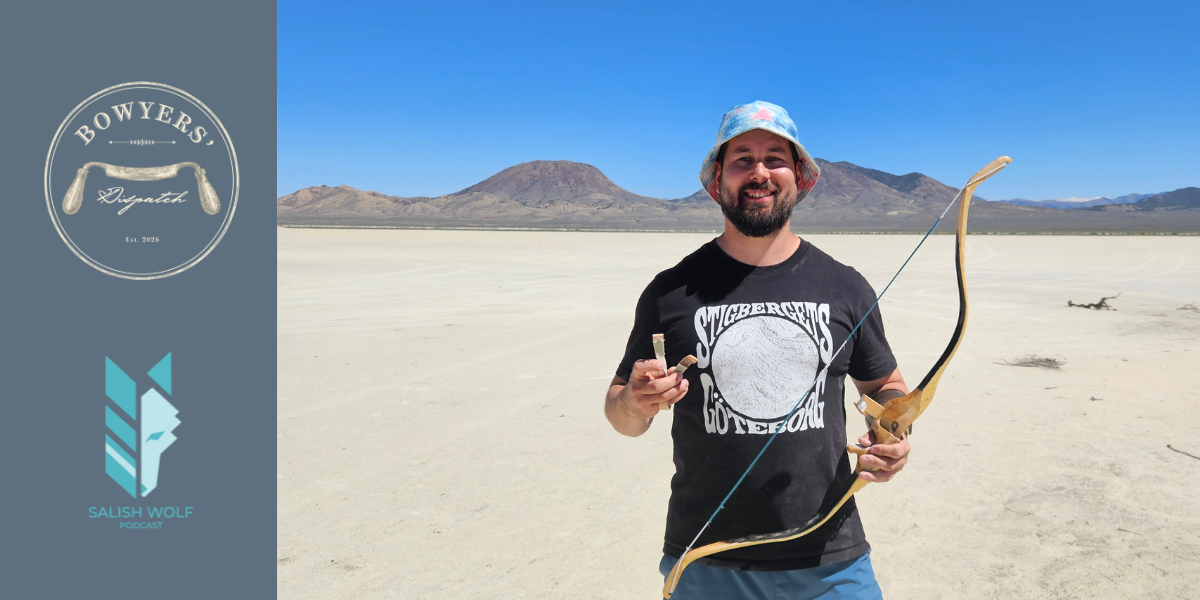
Jere Nyström is a craftsman of Ottoman-style hornbows and a world-record-holding flight shooter. Based in Finland, he has been carving bows for a decade and regularly competes in international flight shooting competitions.
“I’ve been really productive with the hornbows, but I’ve also broken many bows in the pursuit of perfection.”
Please enjoy this episode of the Bowyers’ Dispatch on Salish Wolf with Jere Nyström.
Episode Links:
https://youtube.com/@jerenystrom3303?si=j6nfE4jiZHrlnLrl
https://www.facebook.com/jere.nystrom.7
Quiver at Anchor Point Expeditions
Summary:
Finnish bowyer and flight-archery competitor Jere Nyström explains how his path from self bows led to Ottoman-style hornbows, and why he builds for speed and distance. He discusses his 609-meter primitive hornbow record, historical Ottoman archery, flight-shooting equipment and technique, and the practice behind pushing performance. In Part 2, Finnish hornbow maker and flight archer Jere Nyström explains the hard-won craft knowledge behind building and shooting high-performance Ottoman-style hornbows. He and host Todd discuss bow materials, shaping and curing, safe bracing, heavy-bow training, and the persistence required to master a demanding traditional craft.
Show Notes:
Jere Nyström works as a railway safety engineer in Finland; bow making is a serious hobby driven by experimentation and flight archery.
His progression went from self bows to laminated and sinew-backed bows, then to hornbows, which he has made for roughly six or seven years.
He primarily makes Ottoman-style hornbows with water-buffalo horn and sugar-maple cores, tuning designs to desired draw weights rather than making exact museum replicas.
Nyström described shooting 609 meters with a primitive-material hornbow, silk string, and bamboo arrow; he also cited other class and competition records.
He competes in Istanbul and visits collections including Topkapı Palace to study Ottoman bows, arrows, seipers, thumb rings, and archery equipment.
Flight shooting rewards lightweight, low-drag arrows, but short arrows and powerful bows make precision and release technique especially demanding.
The seiper enables an overdraw, while the mushama grip wrap helps align the bow hand; Nyström explained these tools as part of a tradition focused on maximizing distance.
For primitive categories, natural strings may include flax, silk, gut, or rawhide; Nyström favors silk for its strength and ability to make a light, narrow string.
He studies historical Ottoman records, including manuscripts, and described 846 meters as a historical distance he hopes to approach.
Nyström credits Finnish bow-making peers and international archers with mentorship, collaboration, and shared learning. Nyström describes breaking roughly 30 bows during his first three years, learning that correct limb proportions and enough sinew are crucial to prevent failure.
He demonstrates a hornbow core built from shaped maple, horn, animal glue, and sinew, emphasizing carefully matched limbs and high-quality, crack-free horn.
The bowmaking process includes steam-bending wood, joining the handle, shaping and gluing horn, applying sinew, and allowing long drying and aging periods.
Bracing a highly reflexed hornbow can require specialized sticks, limb supports, and a powerful press; Nyström recounts an accident that fractured a tooth.
Finland's dry climate can challenge glue bonds, while heat affects bow performance; Nyström paints some flight bows to reflect heat and protect their draw weight.
Nyström shoots bows around 130 pounds and has achieved his best results with a 146-pound bow, supported by years of weightlifting and high-draw-weight practice.
His practice routine progresses from a 60-pound warm-up bow to 108- and 116-pound bows, with repeated arrow draws and short-range shooting into a target box.
Nyström and Todd discuss offside shooting, body coordination, and the possibility of changing sides to reset ingrained technique problems.
Indoor practice helps Nyström train through Finland's long, snowy winter, while flight shooting outdoors is limited by access, weather, and the cost of broken arrows.
Power tools speed up stock preparation, but final shaping remains hands-on; Nyström says the best bows benefit from one to two years of storage and curing.
Chapters:
00:00 Meet Jere Nyström, Finnish bowyer and railway safety engineer
04:55 Why maple and water-buffalo horn suit his hornbows
06:15 The challenge that led him to Ottoman-style bows
09:23 Breaking bows to pursue higher performance
11:17 Flight archery and the quest for Ottoman-level speed
12:17 Studying bows and equipment in Istanbul museums
15:12 Istanbul competition versus U.S. record shoots
19:53 The Finnish flight-shooting scene and a 609-meter record
23:47 Why he chooses silk for high-poundage bows
26:26 Ottoman designs, maple cores, and historical accuracy
29:55 A personal pursuit shaped by time, equipment, and workshop space
32:12 Mentors and collaborators in the international bow community
34:13 Historical records and the 846-meter benchmark
37:39 Seipers, overdraw, and Ottoman grip technique
40:18 Why shorter arrows reduce drag
43:22 Flight archery’s military roots and sporting appeal
44:17 Ottoman flight bows and centuries of bowmaking influence
46:15 Thirty broken bows and the lesson of limb proportions
49:37 Building a hornbow core from maple, horn, and glue
52:18 Matching the limbs and managing sinew-induced reflex
54:18 How to brace a powerful, highly reflexed hornbow
58:18 Tillering the horn belly and dealing with Finland's dry climate
01:01:19 Why flight bows are painted to handle heat
01:03:18 Training to shoot bows up to 146 pounds
01:07:07 Offside shooting as a way to reset technique
01:08:04 Nyström's heavy-bow practice routine
01:10:45 Glass practice bows and making training easy to start
01:12:22 Why outdoor flight practice is rare in Finland
01:16:10 Power tools, steam bending, and shaping the bow core
01:18:26 Why hornbows need months or years to cure
01:21:12 The hornbow passion and where Nyström shares his work
01:24:32 Craft, intuition, and the value of learning by hand
